

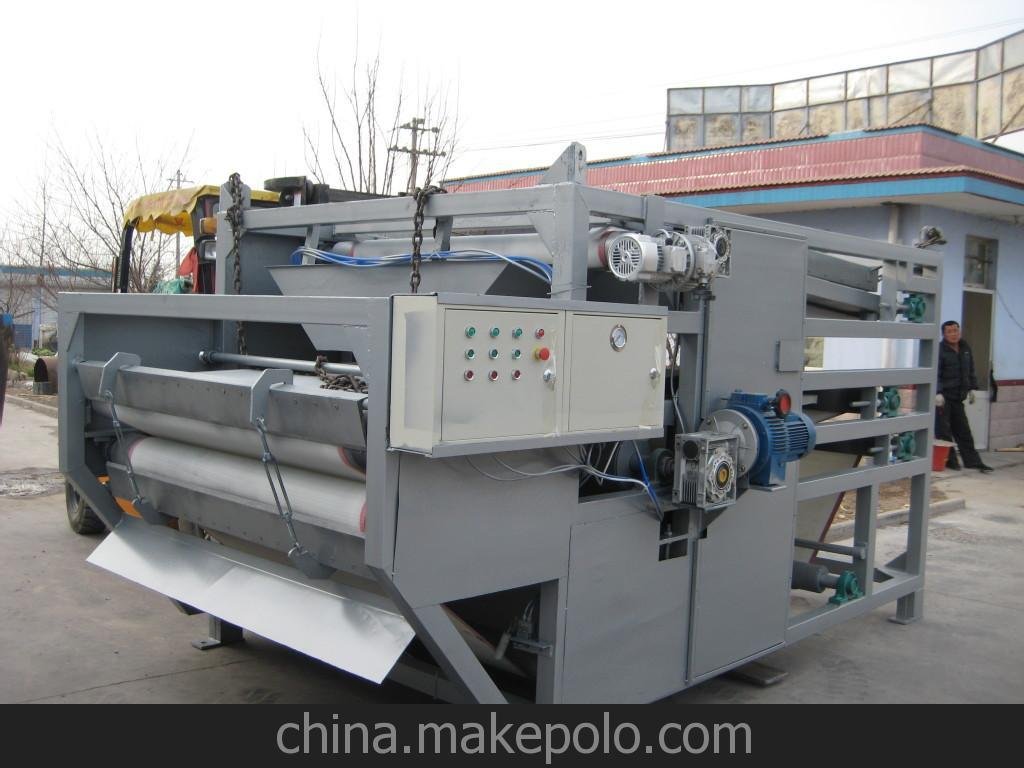
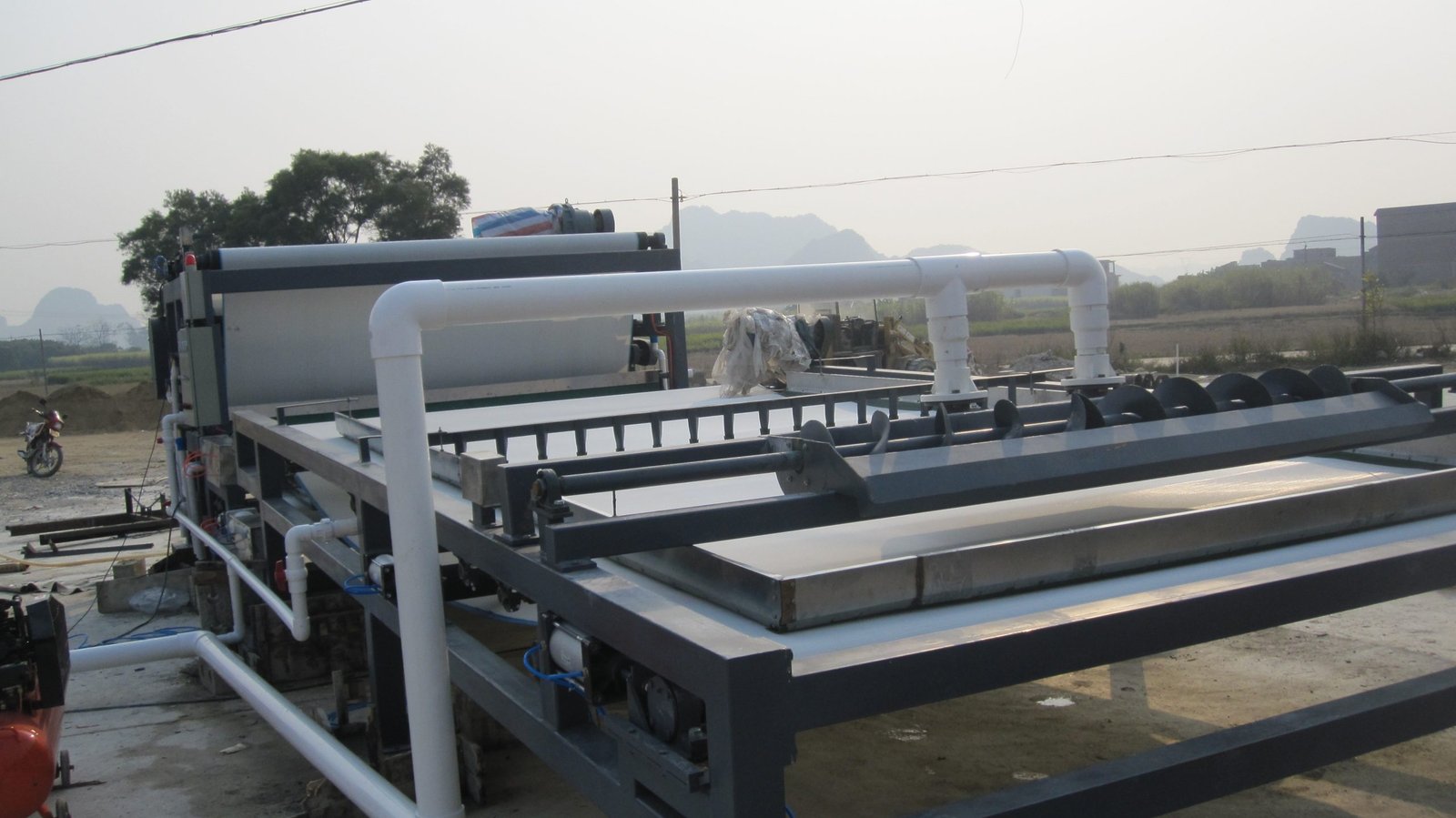
Three-net sludge filter press
Description
Working Principle
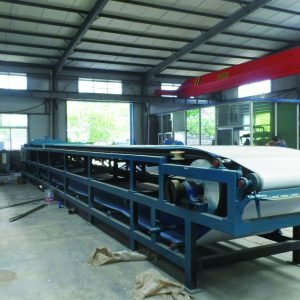
Depending on the pressure of the dehydration zone, the entire dehydration process can be divided into three parts: the pre-dehydration zone of the net, the pressure dehydration zone and the pressure forced dehydration zone.
The slurry is evenly distributed in the pre-dehydration zone on the net through the slurry distributor, and then enters the gravity dehydration zone. In this area, the sewage mainly relies on its own gravity to remove most of the water, so that the slurry loses fluidity and the dehydration concentration is increased to 3-5%. Then it continues to dehydrate on the middle net, and the slurry enters the wedge-shaped intersection area formed by the middle and lower nets, that is, the pressure dehydration zone. In this area, the slurry is slightly squeezed by the middle and lower filter screens, dehydrated to about 15-20%, and then enters the pressure dehydration zone. The pressure dehydration zone consists of 8 dehydration rollers of different diameters, so that both sides of the filter screen are quickly dehydrated during the squeezing process. The diameter of the dewatering rollers is arranged from large to small and the filter screen wrap angle is changed to ensure the formation of increasing dewatering pressure and corresponding shear force, so that the slurry is repeatedly deformed in the “S”-shaped dewatering area and the water concentration is continuously removed to form a mud cake of more than 28-32%, which is finally scraped off by the scraper. The filter screen with the slurry removed is cleaned by high-pressure water and enters the next working cycle.
Structural features
The three-net press consists of several rollers of different diameters and a stirring tank installed on a bracket, and consists of an upper (middle and lower) net driven by a transmission roller, a dewatering roller, a tensioning roller, a guide roller, a deviation correction device, and a sealing device at both ends of the dewatering roller. The filter screen is tightened by compressed air pressure, so that the entire mesh belt maintains a constant tension, and the tension will not change due to changes in feed volume; the machine is also equipped with a pneumatic deviation adjustment device, which is more convenient to operate and manage. The more novel and practical feature is that a sealing device is provided at both ends of at least one or more dewatering rollers. The sealing device consists of a sealing belt and a roller driving the sealing belt. The sealing belt is pressed on the lateral ends after the upper and lower nets overlap, and a tensioning roller is provided between the rollers. As the dewatering roller rotates, the sealing belt and the roller are driven to rotate. In this way, the slurry between the middle and lower nets is squeezed by the sealing belt in addition to the squeezing effect of the dewatering roller, thereby strengthening the dehydration and sealing of the slurry.
Performance characteristics
. Large processing capacity: The three-net sludge filter press has a strong processing capacity and can continuously filter a large amount of sludge.
. High dehydration efficiency: It is made of high-strength materials, the bearings have a long service life, and high-quality filter belts are used to ensure the performance and quality of the filter press.
.Low energy consumption: Compared with other dehydration machines (such as plate and frame filter press, centrifugal dehydrator, vacuum filter), the three-net sludge filter press has the characteristics of low energy consumption, low noise, simple structure, low cost, safety and reliability.
.High degree of automation: The equipment has functions such as automatic deviation adjustment and stepless speed regulation transmission, which is easy to operate and suitable for continuous automated production.
.Easy maintenance: The frame structure is strong, easy to maintain, the overall structure is neat and beautiful, and has excellent anti-corrosion performance, ensuring that it will not rust within five years.
Reviews
There are no reviews yet.